|
|
 |
Geoffrey Gordon Interview
Posted on 24 May 2008. © Copyright 2004-2026
Composition:Today
|
C:T talks to composer Geoffrey Gordon who is currently writing a new piece for the Boston Modern Orchestra Project
 |
|
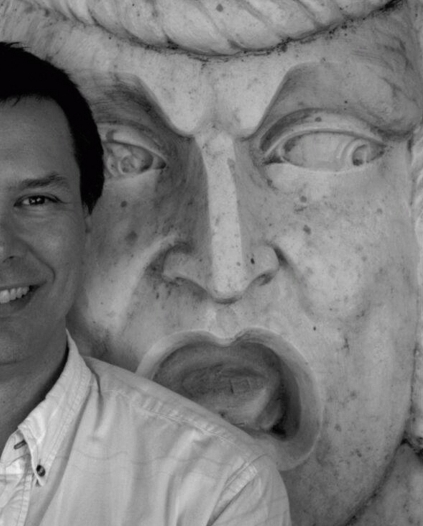
Geoffrey Gordon
|
Tell us something about your background.
I grew up on the East coast of the US—New York mostly, Connecticut—although we moved around quite a bit due to my Dad’s job with General Motors. As a result, I spent my high school years playing rock androll in Detroit … an indulgence which quickly morphed into a love of classical music—fewer drunks, onaverage, in the audience—and opera. I have degrees in vocal performance and composition, and for a time, I pursued both.
How did you start composing?
This morning? Grudgingly. In general, I began writing songs—pop songs, really—on guitar, when I was about twelve. But I always wanted to explore larger forms. I was—and still am—a big Beatles fan, and that, more than anything else, drew me to a variety of musical styles and instruments when I was young. Think of it as a front door to classical music. Later infatuations with opera and bebop jazz pushed metoward the language I use today. I am pleased to say there is evidence of this even in my early scores.(But you’ll have to take my word for it; they’re securely locked away!)
What drives your work, what are you passions?
Good music … interesting sounds … defensible architecture … honestly capturing a text or an idea and conveying it to an audience. Brilliant colleagues. Working hard and getting paid for it.
Tell us something about your working method as a composer. Give us something that might be or might have been a starting point for a piece.
I tend to become more engaged with a piece when I am inspired by a very specific idea or something conceptual, as opposed to “pure” or abstract music (not that I am opposed to that, either, necessarily…!).For example, I am working now on an orchestra piece called Shock Diamonds, which is a reference to the shock waves in the exhaust plume of an aerospace propulsion system—they’re really beautiful, and the words are very evocative, I think. Another example would be a work which premiered in Chicago earlierthis year, called lux solis aeterna. Originally, I had planned to write something derived from the lux aeterna—eternal light: the incipit of the communion chant for a Requiem Mass—but in the course of reading stuff, I came across some research on the study of neutrinos and the creation of sunlight, by Dr.John N. Bahcall (among other things, he helped develop the Hubble Space Telescope). It was positively shot through with amazing, even startling, imagery. (My favorite factoid: about 100 billion neutrinos from the Sun pass through your thumbnail every second!) This dovetailed, in my mind, perfectly with the original concept for the piece, joining the Son with the Sun, if you will. Lux solis aeterna is the result.
Which non-musical influences have affected your music most?
The visual arts, primarily. Lots of my work is inspired by either specific works — like Cool RED Cool, which is a reaction to Andy Warhol’s 1984 Self-Portrait—or techniques usually attributed to the visual arts … like Collage a Trois Trobar, which assembles fragments of 12th and 13th C. troubadour songs into a kind of collage. Poetry continues to be a big influence as well; Ted Hughes has been especially profound in that regard.
What is your musical philosophy?
"Art is either plagiarism or revolution.” —Paul Gauguin
I strive for the second one
Who has been the greatest influence on your musical style to date and why?
Tough question, because it changes all the time. I could say Monteverdi, or John Coltrane. But I’ll go withmy son, Spencer, because since the day he was born, he sharpened and clarified everything for me.
What's the strangest idea for a piece you've ever had?
I’ve been wanting for several years to write a chamber piece based on the Box Tops hit from the late 1960s, Soul Deep--which would require that the ensemble actually sing the song as part of the work. No takers so far. I am also planning a large scale piano piece using fragments of the audio recordings made in Texas prisons in the 1930s. Is that strange?
Which work are you most proud of and why?
That’s a hard one, because you tend to sort of love and hate them all equally. But I’d say, most recently,lux solis aeterna, a chamber orchestra piece premiered in Chicago earlier this season by the excellent group, Fulcrum Point and conductor Stephen Burns. The evolution of this piece (see above) was veryenjoyable to me, and the results—because the piece worked as intended—were very satisfying. I also got lots of gracious comments about the piece from the musicians who played it, which means so much. Idiomatic writing is its own reward.
What does the future hold for you?
The immediate future: new works for the Boston Modern Orchestra Project and the Parker String Quartet,both of which will premiere here in the US in May, 2009. (BMOP in Boston and the Parker SQ in New York.) After that, a number of collaborations, including a new piece for Duo46 and mandolinist Avi Avital,a chamber work for recorder soloist Antje Hensel for the Thüringer Kammermusiktage in Germany, and anew chamber/vocal piece for Carla Rees and her UK ensemble, Rarescale. Lots of performances aroundthe world next season and an opera in 2010.
Please list anywhere online where your work can be experienced
http://www.geoffreygordoncomposer.com
http://www.myspace.com/lcmartistgordon
Please list any useful resouces/links
Oregon Literary Review: http://orelitrev.startlogic.com/v1n2/OLR-gordon.htm
Center for Ted Hughes Studies: http://www3.sympatico.ca/sylviapaul/hughes_music.htm
Wolfhead Music Publishing: http://www.wolfheadmusic.com/comps.htm
ASCAP : http://www.ascap.comPeacock Press: http://www.recordermail.co.uk/peacock_press.htm
Duo46: www.duo46.com
Rarescale: http://myweb.tiscali.co.uk/rarescale/
Boston Modern Orchestra Project: http://www.bmop.org
Parker String Quartet: http://www.parkerquartet.com/
Meet the Composer: http://www.meetthecomposer.org
Fulcrum Point: http://www.fulcrumpoint.org
Symphony Space: http://www.symphonyspace.org/
Concert Artists Guild: http://www.concertartists.org/
Interview by Composition:Today © Copyright 2004-2026
 Comments by other Members Comments by other Members
| |
|
|



