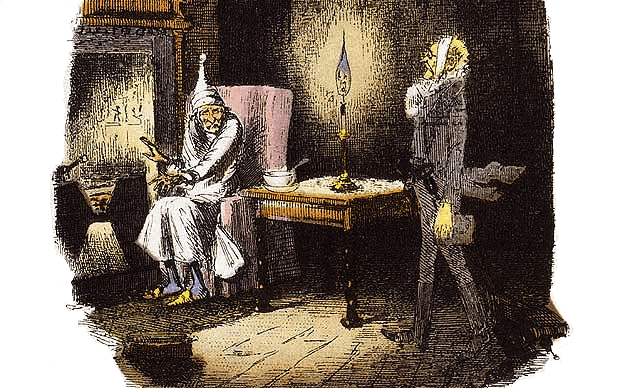
This seasonal story appeared on C:T for the first time in 2014. If it seems strange that, in it, I chose Stravinsky as a composer of contemporary music, I can only say I had my reasons—I needed someone whose style had bridged the romantic and modern eras. Despite this, I think the story still makes its point. I wish you all a very happy and peaceful Christmas!
MAHLER'S GHOST
Mahler was dead, to begin with. There is no doubt whatever about that. The register of his burial was signed by his agent, the conductor, his understudy and the chief mourner. Scrooge would have signed it too had he been there, for Scrooge's name was good upon 'Change, for anything he chose to put his hand to.
Old Mahler, just as Brahms, Beethoven, Mozart and Bach before him, was as dead as a door-nail. The last in a noble line.
Oh! But he was a choosy man as a listener, Scrooge: melody, tonality, species counterpoint and classical forms! Hard and sharp as flint, with a distain for anything that defied the old norms. The excitement of discovery had little influence on him. No melody without tonic, no rhythm without pulse, no harmony without concord. The bitter wind of change blew and he resisted with scornful word and condescending look. But what did Scrooge care? He knew what he liked.
Once upon a time – of all the good days in the year, on Christmas Eve – old Scrooge sat busy in his house. It was cold, bleak, biting weather: foggy withal: and he could hear the people in the court outside, go wheezing up and down, beating their hands upon their breasts, and stamping their feet upon the pavement stones to warm them.
‘A merry Christmas, uncle! God save you!’ cried a cheerful voice from the front door. It was Scrooge’s nephew, who, on being let in, presented his uncle with a small wrapped package.
‘I have a present for you. Open it!’
Reluctantly, Scrooge took the packet and unwrapped it.
‘Bah!’ said Scrooge, ‘Humbug!’ he said.
‘Stravinsky a humbug, uncle!’ said Scrooge’s nephew. ‘You don’t mean that, I am sure?’
‘I do,’ said Scrooge. “‘Stravinsky! All noise I tell you!’
‘Come,’ returned the nephew gaily. ‘I promise you, it is not even difficult Stravinsky: these works were written before the death of your beloved Mahler.’
Scrooge having no better answer ready on the spur of the moment, said, ‘Bah!’ again; and followed it up with ‘Humbug.’
‘Don’t be cross, uncle!’ said the nephew.
‘What else can I be,’ returned the uncle, ‘when I live in such a world of fools as this? Merry Christmas! Stravinsky! You invite me to your concerts of modern Music and you insult me with this present! Every idiot who goes listening to this nonsense should be boiled with his own pudding, and buried with a stake of holly through his heart. He should!”
‘Uncle!’ pleaded the nephew.
‘Nephew!’ returned the uncle sternly, ‘keep to your own Music, and let me keep to mine.’
‘I am sorry, with all my heart, to find you so resolute. We have never had any quarrel, to which I have been a party. But I have made the trial in homage to Christmas, and I’ll keep my Christmas humour to the last. So A Merry Christmas, uncle!’
‘Good afternoon!’ said Scrooge.
‘And A Happy New Year!’
‘Good afternoon!’ said Scrooge.
His nephew left the room without an angry word, notwithstanding.
Left in peace, he closed his door, and locked himself in; double-locked himself in, which was not his custom. Thus secured against surprise, he took off his tie; put on his dressing-gown and slippers, and his nightcap; and sat down before the fire to take his supper. As he threw his head back in the chair, his glance happened to rest upon a bell, a disused bell, that hung in the room, and communicated for some purpose now forgotten with a chamber in the highest story of the building. It was with great astonishment, and with a strange, inexplicable dread, that as he looked, he saw this bell begin to swing.The cellar-door flew open with a booming sound, and then he heard the noise much louder, on the floors below; then coming up the stairs; then coming straight towards his door.
‘It's humbug!’ said Scrooge. ‘I won't believe it.’
His colour changed though, when, without a pause, it came on through the heavy door, and passed into the room before his eyes. Upon its coming in, the dying flame leaped up, as though it cried, ‘I know him; Mahler’s Ghost!’ and fell again.
The same face: the very same. Mahler with his swept-back hair, severe woollen suit, bow-tie and wire-frame glasses. His body was transparent; so that Scrooge, observing him, and looking through his waistcoat, could see the two buttons on his coat behind.
‘How now.’ said Scrooge, caustic and cold as ever. ‘What do you want with me?’
‘Much. I am here tonight to warn you, that you have yet a chance and hope of escaping your fate. A chance and hope of my procuring, Ebenezer. You will be haunted by Three Spirits.’
‘Without their visits,’ said the Ghost, ‘you cannot hope to shun the narrow Musical path you tread. Expect the first to-morrow, when the bell tolls One. Expect the second on the next night at the same hour. The third upon the next night when the last stroke of Twelve has ceased to vibrate. Look to see me no more; and look that, for your own sake, you remember what has passed between us!’
THE FIRST OF THE THREE SPIRITS
The following night Scrooge lay in his bed when he remembered, on a sudden, that the Ghost had warned him of a visitation when the bell tolled one. He resolved to lie awake until the hour was passed; and, considering that he could no more go to sleep than go to Heaven, this was, perhaps, the wisest resolution in his power.
The quarter was so long, that he was more than once convinced he must have sunk into a doze unconsciously, and missed the clock. At length it broke upon his listening ear.
‘Ding, dong!’
‘A quarter past,’ said Scrooge, counting.
‘Ding, dong!’
‘Half-past!’ said Scrooge.
‘Ding, dong!’
‘A quarter to it,’ said Scrooge.
‘Ding, dong!’
‘The hour itself,’ said Scrooge triumphantly, ‘and nothing else!’
He spoke before the hour bell sounded, which it now did with a deep, dull, hollow, melancholy One. Light flashed up in the room upon the instant, and the curtains of his bed were drawn aside; and Scrooge, starting up into a half-recumbent attitude, found himself face to face with the unearthly visitor.
It was a strange portly figure with a white wig. It wore a long navy coat, white knee breeches and socks and buckled black shoes. In one of its delicate jabot and lace cuffed hands it held a piece of brown parchment.
‘Are you the Spirit, sir, whose coming was foretold to me?’ asked Scrooge.
‘I am.’
The voice was soft and gentle. Singularly low, as if instead of being so close beside him, it were at a distance.
‘Who, and what are you?’ Scrooge demanded.
‘I am the Ghost of Music Past.’
‘What do you want of me?’
‘Rise! and walk with me!’
It would have been in vain for Scrooge to plead that the weather and the hour were not adapted to pedestrian purposes; that bed was warm, and the thermometer a long way below freezing; that he was clad but lightly in his slippers, dressing-gown, and nightcap; and that he had a cold upon him at that time. The grasp, though gentle as a woman's hand, was not to be resisted. He rose: but finding that the Spirit made towards the window, clasped his robe in supplication.
‘I am mortal,’ Scrooge remonstrated, ‘and liable to fall.’
‘Bear but a touch of my hand there,’ said the Spirit, laying it upon his heart, ‘and you shall be upheld in more than this!’
As the words were spoken, they passed through the wall and stood in the chancel of a large church. Scrooge's house had entirely vanished. Not a vestige of it was to be seen. The bulky walls of the building were broken by small arched windows, which let in so little light that it took Scrooge's eyes a moment to adjust. A choir of monks was rehearsing in the gloom.
‘Good Heavens!’ said Scrooge, clasping his hands together, as he looked about him. ‘Who are these people?’
‘These are but shadows of people that have been,’ said the Ghost. 'They have no consciousness of us. Watch and listen'
The strange sounds filled the building. Scrooge was perplexed.
‘What is this Music? It is beautiful in its way,’ he said.
‘You sound uncertain,' said the Spirit.
‘I don’t know, it sounds…’ Scrooge struggled to find the right word.
‘…empty.’
‘It is organum.’ said the Spirit.
‘What is that?’ asked Scrooge, who had the feeling that a trick had been played upon him.
‘A type of Music common at this time. You only need to know that it is different.’
‘I cannot see how that concerns me,’ said Scrooge.
‘You stand here at the very source of all you love. It concerns you a great deal.’
Before Scrooge could reply the Spirit had taken his hand. He led him down the chancel steps before motioning him to turn back towards the high altar.
To Scrooge's astonishment the scene had changed: he now found himself in lavish courtly surroundings. There was a smaller group of singers and an informal audience of eminent personages in various positions of elegant repose. The men sported pointed beards and wide moustaches and wore close-fitting doublets, hose and breeches. Of the women, Scrooge’s eye was drawn to one more splendid than the rest. She sat apart with a pearl headdress, ruff, a finely embroidered blue doublet with a high neckline and matching skirts.
‘Who is that?’ asked Scrooge.
‘That is Margherita of Austria, bride of Philip III of Spain.’
‘And where are we?’
‘Mantua’ replied the Spirit.
Scrooge listened to the singers and quickly found himself engrossed. The beauty of the voices, the finely wrought counterpoint and, above all, the agonising and exquisite harmonies. Tears came to his eyes.
‘You are emotional,’ said the Spirit.
‘I cannot help it, this Music, it…’
Scrooge’s search for a superlative was interrupted by the sound of a chair scraping on the floor. One of the audience had sprung angrily to his feet and was walking noisily from the room.
‘Disgraceful!’ cried a scandalised Scrooge. ‘Who would interrupt such beautiful Music.’
‘A man who, perhaps, found these harmonies a little trying.’
‘Trying! I cannot believe it!’
‘Believe it you must. That man is Giovanni Maria Artusi. He will soon be writing a book called The Imperfections of Modern Music.’
Scrooge was incredulous. ‘Imperfections? I cannot imagine a Music more perfect’ He would have continued but his eye was caught by a member of the small choir, a man in his thirties, who looked as enraged as the man who had stormed out.
’Who is that?’
‘He is Claudio Monteverdi.’
‘Of course!’ cried Scrooge, ‘He is the composer. I am not surprised he is angry.’
‘The path of the modern composer is never easy…’
The Spirit looked pleased with himself. Scrooge was beginning to guess the game.
‘You show me these visions to what end?’
‘That tastes change,’ replied the Spirit ‘and Music progresses. You found the open harmonies of the organum dull compared to the Music you prefer. Imagine if those monks had been listening to this Monteverdi madrigal. How might they have reacted when even Monteverdi’s contemporaries found it shocking?’
Scrooge thought for a moment. ‘You make a good argument Spirit. I can see that what you say is true but how can I change the Music I like? Modern Music is so difficult, so complicated.’
'All will become clear'
Seeing that the ghost looked upon him with disdain, Scrooge became angry.
'Why do you mock me?' he exclaimed. 'Take me back. Haunt me no longer!”
He was suddenly conscious of being exhausted, and overcome by an irresistible drowsiness; and, then, of being in his own bedroom. He had barely time to reel to bed, before he sank into a heavy sleep.
THE SECOND OF THE THREE SPIRITS
Awaking in the middle of a prodigiously tough snore, Scrooge found his bed the very core and centre of a blaze of ruddy light, which streamed upon it when the clock proclaimed the hour of one; and which, being only light, was more alarming than a dozen ghosts, as he was powerless to make out what it meant, or would be at. At last, however, he began to think that the source and secret of this ghostly light might be in the adjoining room, from whence, on further tracing it, it seemed to shine. This idea taking full possession of his mind, he got up softly and shuffled in his slippers to the door.
The moment Scrooge's hand was on the lock, a strange voice called him by his name, and bade him enter. He obeyed.
It was his own room. There was no doubt about that. But it had undergone a surprising transformation. He was looking at a schoolroom, more specifically a Music room. There was a piano and stereo system and several rough lines of chairs. On each was seated a fidgeting and excited child. As well as a large whiteboard, the walls were adorned with posters of composers: a plump and contented looking Bach, a dishevelled Beethoven, a hugely foreheaded Berlioz. There were also some other figures – Schoenberg, Stravinsky and Shostakovich – and also many others he had never heard of.
‘I am the Ghost of Music Present,’ said the Spirit.
Scrooge entered timidly, and hung his head before this Spirit. He was not the dogged Scrooge he had been; and though the Spirit's eyes were clear and kind, he did not like to meet them.
‘Spirit,’ said Scrooge submissively, ‘conduct me where you will. I went forth last night on compulsion, and I learnt a lesson which is working now. Tonight, if you have aught to teach me, let me profit by it.’
‘From these children shall ye learn!’
Another figure, a young man, was now in the room. He was putting a CD into the stereo system.
‘Remember’ he said ‘when you close your eyes to think of the Musical elements: tempo, texture, timbre, dynamics, duration, pitch and pulse. But, also, I want to know what you feel.’
Half-expecting some Mozart or Beethoven – something, he thought condescendingly, that would challenge these young minds – Scrooge was stupefied to hear a score of astonishing complexity and dissonance.
He recognised the opening words, Kyrie Eleison. But this was no cheerful Mozart Mass setting; it was a terrible and awesome wall of sound.
‘Where is the melody? Where is the harmony? I cannot make sense of this,’ opined Scrooge.
‘Your ears are dulled by the familiar. You must learn to listen anew.’
After a few minutes the teacher faded the Music out.
‘Who wants to tell me something about this piece. What about the dynamics?’ he asked.
Twenty hands shot up, twenty posteriors bounced on chairs.
Child 1: ‘Started quietly sir and got louder!’
‘As simple as that?’
Child 2: ‘No sir. It got quieter again at the end.’
‘And the texture?’
Child 3: ‘It started thin, there wasn’t much going on, but then there was more and more.’
‘Ok, good, so how would you describe the things going on? What about the duration of the notes?’
Child 4: ‘Lots of very fast short notes, all at the same time!’
‘Anything else?’
Child 2 again (smart aleck): ‘No, there were some long notes every now and again’
‘What about the timbre of the notes? What instruments could you hear?’
Child 5: ‘Well, mostly the quick bits were with singing, but the long notes were played by instruments.’
‘And the pitch? Did anyone notice what happened at the end?’
Child 6: ‘It got higher’
Child 7: ‘Yes, but that stopped at the end leaving lower sounds underneath’
The teacher took out a pen and drew three shapes on the whiteboard: a rectangle, a wedge shape starting with the widest section and gradually tapering off to a point and a wedge that did the exact reverse.’
‘If you had to choose one of these shapes to describe the Music, which would it be? Who votes for the first?’
One hand, quickly withdrawn. Disgusted looks from the others.
‘The second?’
Not a single hand.
‘The third?’
Every hand shot up.
Child 2 (again!): ‘But maybe you should also put a little shape at the end to show it getting quiet.’
‘Quite right too!’ said the young man, well content. ‘And what did you think of the Music? Did you like it?’
Chorus of children: ‘Yes! It was spooky! Scary! Sounded a bit spacey! To infinity and beyond!’
The Ghost turned to Scrooge. ’Do you still think modern Music is too complicated to understand?’ he asked.
Scrooge felt hot with embarrassment. ‘No,’ he answered simply.
‘You listen to Music expecting certain things, especially you expect tonal harmony and melody. As soon as these things are absent you switch off your ears and close your mind. Children have no such preconceptions. They listen without prejudice and so hear without limit.’
‘How then can I free my mind?’
‘I have one more thing to show you’
The Ghost took Scrooge’s hand and suddenly found himself high in the air and moving with great speed. It was a great surprise to Scrooge, while listening to the moaning of the wind, and thinking what a solemn thing it was to move on through the lonely darkness over an unknown abyss, whose depths were secrets as profound as Death: it was a great surprise to Scrooge, while thus engaged, to hear a hearty laugh. It was a much greater surprise to Scrooge to recognise it as his own nephew's and to find himself in a bright, gleaming room, with the Spirit standing smiling by his side, and looking at that same nephew with approving affability.
‘Ha, ha!’ laughed Scrooge's nephew. ‘Ha, ha, ha!’
‘He said that modern Music was a humbug, as I live!’ cried Scrooge's nephew. ‘He believed it too!’
‘More shame for him, Fred!’ said Scrooge's niece, indignantly.
‘He's a comical old fellow,’ said Scrooge's nephew, ‘that's the truth: and not so pleasant as he might be. However, his offences carry their own punishment, and I have nothing to say against him.’
‘I have no patience with him,’ observed Scrooge's niece.
‘Oh, I have!’ said Scrooge's nephew. ‘I am sorry for him; I couldn't be angry with him if I tried. Who suffers by his ill whims? Himself, always. He takes it into his head to dislike anything written after Mahler. What's the consequence? He misses a whole world of Music.’
‘But perhaps’, said one of his friends, ‘your old Scrooge is right. Why shouldn’t he listen to what he likes?’
‘My good man, you entirely miss the point. He is like a child who refuses new foods. I do not object to him listening to what he likes, but I object most strongly to him not trying new things.’
‘But your analogy does not work,’ his friend protested, ‘one can avoid the taste of new food by the simple act of refusing to put it in one’s mouth. That is childish indeed. Music is everywhere. He cannot fail to have heard some New Music so, even though he avoids it, his opinion is based on real data.’
‘Ah, but how many of us talk about “the acquired taste” when we talk about those marvellous flavours that we eschew as children. We have to work to acquire them. Once cultivated, life becomes rich indeed.’
‘Life without the great classical composers before Mahler is not rich enough?’
‘Simply not as rich as it could be. How can it be when you consider the enormous variety of Music written since that time? Actually, given that there is such a variety, he has even less excuse not to listen to it’
‘What can you mean?’
‘Some of our most eminent living composers do not pose a stylistic challenge in the way that he perceives it. Our first reaction when listening to Glass, Adams or Reich is not to bemoan the astringency of the harmonies and the impossible intricacies of the serial method. I am saying that, even given his current tastes, there are marvellous pieces he could listen to today without any great effort. He simply needs to be more inquisitive.’
‘But that is still an admission that he will never get to grips with more challenging fare’
‘What I refer to is a gradual opening of the mind. Of course if one begins with Boulez or Birtwistle, there is a possibility that a listener will perceive all the Music of our time as being difficult and stop listening. That is why I tried to give him some early Stravinsky today. The same composer who wrote the Requiem Canticles at the end of his life also wrote Fireworks and Firebird at the beginning. This is a microcosm of Music of our time; there is a multiplicity of styles. If you find some of it bewildering that is not an excuse not to listen, but to find something else, and perhaps try that which bewildered you again later.’
‘Anyway,' said Scrooge's nephew, becoming cheerful again, 'at least his oddities provide with us with good conversation, so it would be ungrateful not to drink his health. Here is a glass of mulled wine ready to our hand at the moment; and I say, “Uncle Scrooge!”’
‘Uncle Scrooge!’ they cried.
‘A Merry Christmas and a Happy New Year to the old man, whatever he is.’ said Scrooge's nephew. ‘He wouldn't take his present from me, but may he have it, nevertheless. Uncle Scrooge!’
Scrooge was so gay and light of heart, to hear his health so heartily drunk. Neither had the lesson been wasted upon him:
‘I do believe that my nephew is right. Perhaps there is something to be gained by being a little more adventurous in my listening habits. I will look into it when I have a moment.’
‘You feel no urgency?’
‘Is there any?’ asked Scrooge.
‘Very much so.’
The whole scene passed off in the breath of the last word spoken by the Spirit; and he and Scrooge were again upon their travels. It had been a long night, if it were only a night; but Scrooge had his doubts of this, because the Christmas Holidays appeared to be condensed into the space of time they passed together. It was strange, too, that while Scrooge remained unaltered in his outward form, the Ghost grew older, clearly older. Scrooge had observed this change, but never spoke of it, until, as they stood together in an open place, he noticed that its hair was grey.
‘Are spirits’ lives so short?’ asked Scrooge.
‘My life upon this globe, is very brief,’ replied the Ghost. ‘It ends tonight.’
‘Tonight!’ cried Scrooge.
‘Tonight at midnight. Hark! It is already time.'
The chimes were ringing twelve.
Scrooge looked about him for the Ghost, and saw it not. As the last stroke ceased to vibrate, he remembered the prediction of old Mahler, and lifting up his eyes, beheld a solemn Phantom, draped and hooded, coming, like a mist along the ground, towards him.
THE LAST OF THE SPIRITS
The Phantom slowly, gravely, silently approached. When it came, Scrooge bent down upon his knee; for in the very air through which this Spirit moved it seemed to scatter gloom and mystery.
It was shrouded in a deep black garment, which concealed its head, its face, its form, and left nothing of it visible save one outstretched hand. But for this it would have been difficult to detach its figure from the night, and separate it from the darkness by which it was surrounded.
He felt that it was tall and stately when it came beside him, and that its mysterious presence filled him with a solemn dread. He knew no more, for the Spirit neither spoke nor moved.
‘I am in the presence of Music Yet To Come?’ said Scrooge.
The Spirit answered not, but pointed onward with its hand.
‘You are about to show me shadows of the things that have not happened, but will happen in the time before us,’ Scrooge pursued. ‘Is that so, Spirit?’
The upper portion of the garment was contracted for an instant in its folds, as if the Spirit had inclined its head. That was the only answer he received.
Although well used to ghostly company by this time, Scrooge feared the silent shape so much that his legs trembled beneath him, and he found that he could hardly stand when he prepared to follow it.
‘Ghost of the Future!’ he exclaimed, ‘I fear you more than any spectre I have seen. But as I know your purpose is to do me good, and as I hope to live to be another man from what I was, I am prepared to bear your company, and do it with a thankful heart. Will you not speak to me?’
It gave him no reply. The hand was pointed straight before them.
The Phantom moved away as it had come towards him. Scrooge followed in the shadow of its dress, which bore him up, he thought, and carried him along.
A churchyard. Walled in by houses; overrun by grass and weeds, the growth of vegetation's death, not life; choked up with too much burying; fat with repleted appetite.
The Spirit stood among the graves, and pointed down to One. He advanced towards it trembling. The Phantom was exactly as it had been, but he dreaded that he saw new meaning in its solemn shape.
‘Before I draw nearer to that stone to which you point,’ said Scrooge, ‘answer me one question. Are these the shadows of the things that Will be, or are they shadows of things that May be, only?’
Still the Ghost pointed downward to the grave by which it stood.
‘Men's courses will foreshadow certain ends, to which, if persevered in, they must lead,’ said Scrooge. ‘But if the courses be departed from, the ends will change. Say it is thus with what you show me!’
The Spirit was immovable as ever.
Scrooge crept towards it, trembling as he went; and following the finger, read upon the stone of the neglected grave the Spirit’s own name:
Music Yet to Come
‘It cannot be!’ he cried, upon his knees.
The finger pointed from the grave to the Phantom himself, and back again.
‘No, Spirit! Oh no, no!’
The finger still was there.
‘Spirit!’ he cried, tight clutching at its robe, ‘hear me! I am not the man I was. I will not be the man I must have been but for this intercourse. Why show me this, if it is beyond all hope?’
For the first time the hand appeared to shake.
‘Good Spirit,’ he pursued, as down upon the ground he fell before it: ‘I understand. Finally, I understand. I have always loved and honoured Music. I have fawned and doted upon composers, but never once have I stopped to listen to the Music of my time. I never realised that there was such variety and richness, that I already possess the faculties for comprehending it, if only I tried to be a little more adventurous.’
‘I will not let Music die. Oh, tell me I may sponge away the writing on this stone!’
In his agony, he caught the spectral hand. It sought to free itself, but he was strong in his entreaty, and detained it. The Spirit, stronger yet, repulsed him.
Holding up his hands in a last prayer to have his fate reversed, he saw an alteration in the Phantom's hood and dress. It shrunk, collapsed, and dwindled down into a bedpost.
THE END OF IT
Yes! and the bedpost was his own. The bed was his own, the room was his own. Best and happiest of all, the Time before him was his own, to make amends in!
‘I will not let Music die!’ Scrooge repeated, as he scrambled out of bed. ‘The Spirits of all Three shall strive within me. Oh, Gustav Mahler! Heaven, and the Christmas Time be praised for this! I say it on my knees, old Gustav, on my knees!’
He was so fluttered and so glowing with his good intentions, that his broken voice would scarcely answer to his call. He had been sobbing violently in his conflict with the Spirit, and his face was wet with tears.
Scrooge was better than his word. He listened. Oh how he listened! Berg, Boulez, Benjamin; Messiaen, Murail, MacMillan; Stravinsky, Simpson, Saunders. The modern classics and the classics in the making. He bought tickets to concerts and evangelised. The occasional piece he did not like he did not cast aside, granting instead that, perhaps, he had not fully understood it or that a second or third listening might be required. He did not forget the old composers. In fact, his knowledge of the repertoire helped him better understand the Music of his own time.
Some people laughed to see the alteration in him, but he let them laugh, and little heeded them; for he was wise enough to know that nothing ever happened on this globe, for good, at which some people did not have their fill of laughter in the outset; and knowing that such as these would be blind anyway, he thought it quite as well that they should wrinkle up their eyes in grins, as have the malady in less attractive forms. His own heart laughed: and that was quite enough for him.
He had no further intercourse with Spirits, but lived upon the Total Abstinence Principle, ever afterwards; and it was always said of him, that he knew his Music, if any man alive possessed the knowledge. May that be truly said of us, and all of us! And so, God bless Us, Every One!


 Christian Morris
 Whilst 2020 is likely to be dominated by Beethoven’s 250th, there are also several living composers who have significant birthdays in 2020. These include the 95th of Mikis Theodorakis (29th July), the 90th of Dieter Schnebel (14th March), Harald Banter (16th March) and Jean Guillou (18th April), the 80th of Alvin Singleton (28th December) and, most significantly in a British context, the 60th of Mark-Anthony Turnage.

 Industry body UK Music has called upon the British government to recognise the power of music to improve wellbeing and boost the development of young people
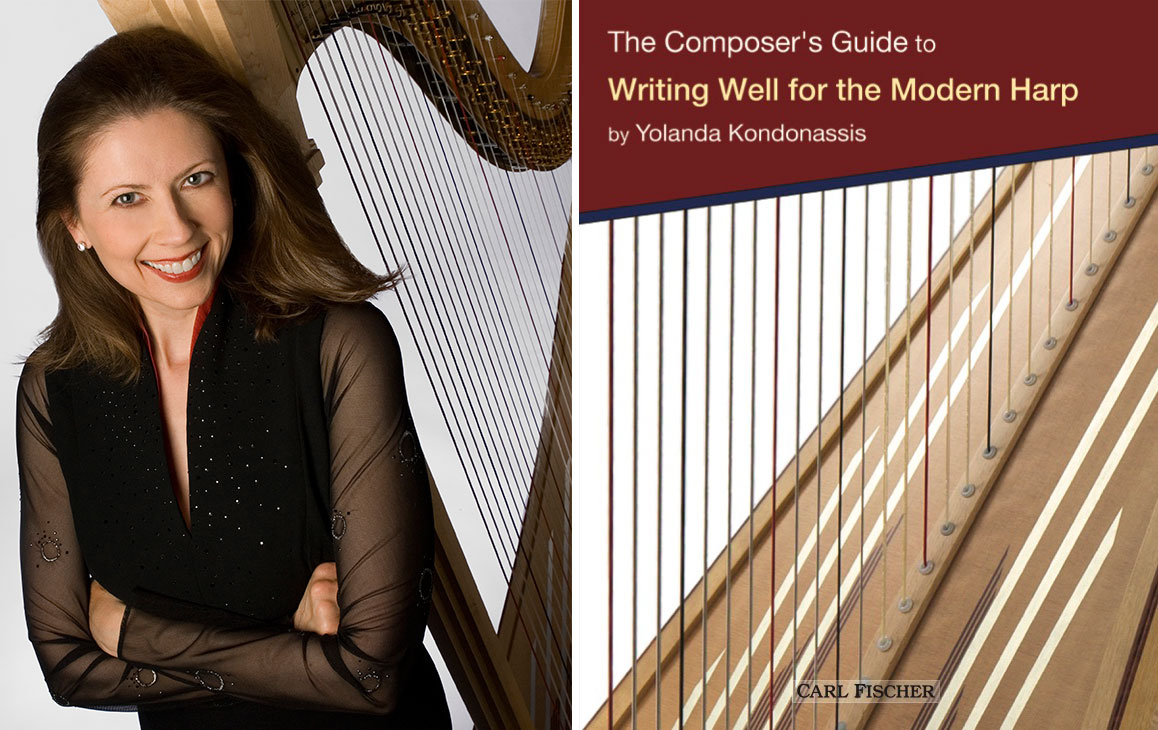 Harpist Yolanda Kondonassis has announced the release of her new book, The Composer’s Guide to Writing Well for the Modern Harp (Carl Fischer Music), a comprehensive guide and conversational text on composing idiomatically for the harp. The book features 22 detailed chapters on a full spectrum of topics, including technical logistics, chromaticism, notation, context, resonance management, special effects, and more.
 Music by Numbers 2019 - industry contributes £5.2 billion to UK economy
 CompositionToday
offers a huge range resources exclusively for composers.
CompositionToday
offers a huge range resources exclusively for composers.