|
|
 |
Eric Sawyer Interview
Posted on 26 July 2008. © Copyright 2004-2026
Composition:Today
|
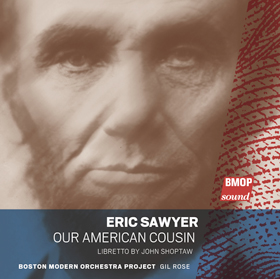
C:T talks to composer Eric Sawyer, whose piece Our American Cousin - about the fateful day of Abraham Lincoln’s death - is released on the BMOP/sound label released this month.
 |
|
Our American Cousin by Eric Sawyer, recorded by BMOP
|
Tell us something about your background.
I grew up in Southern California and lived much of my adult life in Boston, settling eventually in Amherst, Massachusetts. I remain a loyal Californian in my attachment to nature and resistance to breaking the world down too much into categories.
How did you start composing?
From my early studies of piano I tried to emulate the music I heard and played. Though I heard all types of music, classical music grabbed me first. My tastes moved forward in time, with Bach the origin and foundation, the classical forms an important way station, and the sounds of the twentieth century, both classical and popular, taking hold during my teenage years. I wouldn’t say I have left any of these stages behind, rather built on top of them.
What drives your work, what are you passions?
Contradictory as it sounds, my passion is for a balance of structure and expression. Why should one have to choose? All the music I am crazy about has both, with the expression probably being primary but always being supported by a logic that can be investigated and connected with the character in utterly fascinating ways.
I am passionate about clarity, and about finding the best choices.
Tell us about Our American Cousin and the new recording that's out.
Our American Cousin is an opera that tells the story of Abraham Lincoln’s assassination from the viewpoint of those who were there: the actors and audience of Ford’s Theater. The opera has a double narrative, a slapstick comedy within a serious historical drama, and the music draws on a wide vocabulary of American music in an overall style of lyrical extended tonality. After a long period of workshops and a complete concert performance, the opera received its stage premiere in June 2008 and was released in recording at the same time by the Boston Modern Orchestra Project on the orchestra’s new label, BMOP/sound.
Tell us something about your working method as a composer. Give us something that might be or might have been a starting point for a piece.
Things seem to go best if I’m working right on the edge of my understanding. Order does not have to be willed; it just has to be noticed and then begets more order. The sensitivity to the evolving order of a work builds a kind of scaffolding from which the intuition can reach.
Works with words are quite different from ‘abstract’ pieces, in that they impose an outside structure and sensibility that has to be adjusted to. This adjustment is often the catalyst to the whole piece. Lacking an exterior text, I find myself looking for or waiting for problems that require similar adjustments that will catalyze my work. There always has to be something new, as far as challenging my own familiar territory.
Which non-musical influences have affected your music most?
I have been drawn into a number of projects involving American myth, the treatment of the Lincoln assassination in Our American Cousin being the largest. I enjoy material that resonates from the past to the present with potential both for civic relevance and historical distance. Among contemporary art forms, I am drawn especially to modern novels for their refreshed sense of narrative, access to the language of everyday life, and simultaneous sense of distance and strangeness of the everyday they can provide.
What is your musical philosophy?
Place nothing off limits as far as legitimate musical material. If something lodges in your ear, you have a right to it, conditional on doing the work to make it fit, both logically and expressively. It is hard to discover new sounds, but context can give the great variety of sounds we have renewed vitality and meaning.
What's the strangest idea for a piece you've ever had?
A few years ago I encountered a wonderful poem, Itasca by John Shoptaw, who is also the librettist to my opera. Unlike the libretto, Itasca was not written to be sung, and its oblique narrative of the exploration of the Mississippi headwaters is told in many voices. My setting ended up mooring declaimed speech to a meter expressed in loops of water sounds, with other electronics dancing around the fixed meter and strands of song woven around the speech. And the singers were costumed and choreographed, for good measure. For all its strangeness, I do think the staged performance succeeded in bringing the poem off of the page and into the theater.
Which work are you most proud of and why?
I would have to say Our American Cousin. It is so satisfying to see such a large project reach fulfillment, and opera gives an opportunity for one’s music to reach out in ways I certainly hadn’t experienced before. Among my instrumental pieces, I am especially proud of my Third String Quartet, which felt like an arrival after years of struggle with this challenging genre.
What does the future hold for you?
I am enjoying writing smaller pieces these days. Perhaps another opera lies ahead. I’ve always just followed my muse where it leads.
Please list anywhere online where your work can be experienced
There are music links both on my website: http://www.ericsawyer.net ; and on the website for Our American Cousin: htpp://www.ouramericancousin.com
Please list any useful resouces/links
My commercially-available recordings are: Our American Cousin (BMOP/sound 1006), String Works (Albany Records Troy781) and The Humble Heart (Albany Records Troy988).
BMOP/sound http://www.bmopsound.org
Interview by Composition:Today © Copyright 2004-2026
 Comments by other Members Comments by other Members
| |
|
|



